
Welcome to our new Website! If you experience problems logging in, please contact us by email at support@south-bay-bio.com or by phone at (415) 935-3226 immediately for assistance!
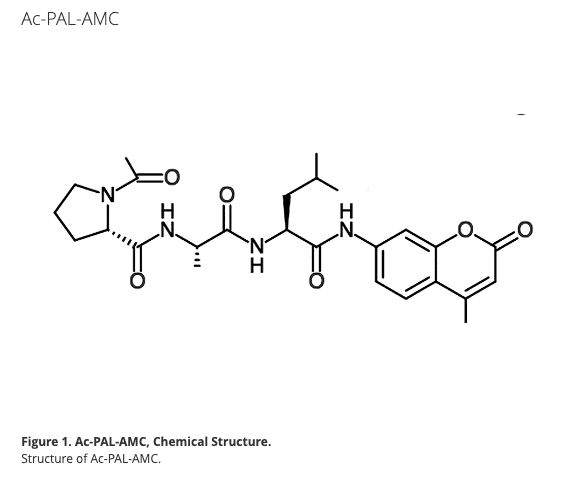
Catalog number: SBB-PS0007, 2 mg
Ac-PAL-AMC (Acetyl-Pro-Ala-Leu-AMC) is a 7-amino-4-methylcoumarin labeled fluorogenic peptidyl substrate hydrolyzed by the β1i subunit of the 20S immunoproteasome. Peptidylglutamyl-peptide hydrolyzing (Caspase-like) activity can be measured using a working concentration of 20-50μM substrate. This substrate is specific to the immunoproteasome, and is not hydrolyzed efficiently by the constitutive proteasome. Cleavage of this peptide by the immunoproteasome or other enzymes liberates the fluorophore AMC causing a strong fluorescent signal which is detected at an Excitation wavelength of 345nm and Emission wavelength of 445nm. 20S Proteasome enzyme requires activation with 0.035% SDS in the assay buffer.
$139.00
Catalog number: SBB-PS0007, 2 mg
Ac-PAL-AMC is a fluorogenic peptidyl substrate for measuring caspase-like activity of the immunoproteasome. Hydrolysis of this substrate by the β1i subunit of the immunoproteasome is monitored by observing fluorescence at an Excitation wavelength of 345nm and Emission at 445nm.
Quantity
Total
$139.00
Free Same-day Shipping on Domestic Orders over $750
| Quantity: | 2.0 mg |
|---|---|
| Molecular Weight: | 498.6 Da |
| Purity: | >99% by HPLC |
| Readout: | Endpoint / Kinetic |
| Label or Dye: | 7-Amino-4-methylcoumarin |
| Detection Method: | Fluorescence |
| Substrate Properties: | Protein-Based Substrate, C26H34N4O6 |
| Excitation/Emission (nm): | 345/445 |
| Storage Buffer: | Lyophilized |
| Storage | Store at 4°C after product arrival. After preparing a stock in DMSO ( ≥10 mM) store product at -20°C to −80°C. It is recommended to make multiple aliquots after the first thaw to ensure best performance. |
Certificate of Analysis
Open Certificate in New TabCitations and References
1) Park, Ji Eun, et al. "PSMB9 codon 60 polymorphisms have no impact on the activity of the immunoproteasome catalytic subunit B1i expressed in multiple types of solid cancer." PloS one 8.9 (2013): e73732. 2) Miller, Zachary, et al. "Inhibitors of the immunoproteasome: current status and future directions." Current pharmaceutical design 19.22 (2013): 4140-4151. 3) Dubiella, Christian. Development and Characterization of Selective Immunoproteasome Inhibitors. Diss. Universität München, 2015.